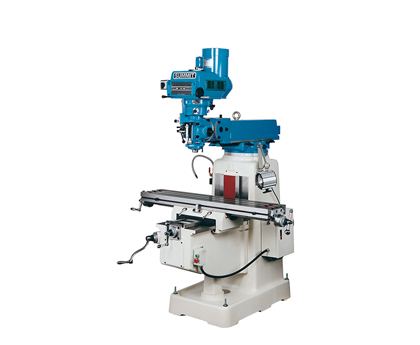
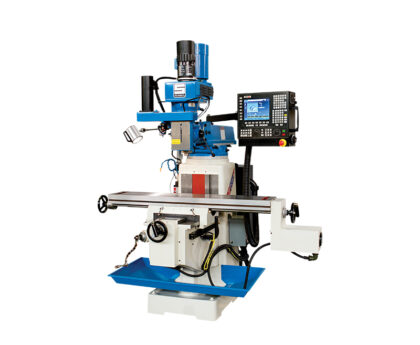
Vertical milling machines come in two basic variations; bed mills and knee mills. Both mills operate on the same principles – a vertically mounted spindle holds a cutting tool which is lowered into the workpiece mounted below.
Knee Mills vs. Bed Mills
While both vertical knee mills and bed mills belong to the same family of vertical milling machines, their designs make them better suited for different types of milling operations. Bed mills are built for rigidity and precision when handling heavy or large workpieces. Instead of the table moving vertically, the spindle head moves up and down along the column, while the worktable remains fixed in place.
This design minimizes vibration and deflection, which is especially important when machining hard metals or large workpieces with tight tolerances. Bed mills may lack some of the quick adjustability of knee mills, but their strength and stability make them ideal for industries like aerospace, automotive, and heavy equipment manufacturing.
A knee mill, with its adjustable knee and vertically moving table, offers flexibility to accommodate unusually shaped parts or awkward workpieces. Operators can quickly set up small- to medium-sized parts and adjust cutting depth on the fly. This range of machining capabilities makes knee mills excellent for prototyping, educational settings, repair work, and small-batch production. Their relatively compact size also makes them a perfect solution for toolrooms and machine shops with diverse needs where space is limited.
In short, knee mills excel in versatility and accessibility, while bed mills shine in durability and accuracy for demanding production environments.
Vertical Knee Milling Machines
Among vertical milling machines, the knee mill is one of the most iconic and widely used designs. Named for its adjustable “knee,” this type of milling machine allows the operator to move the worktable up and down along the column, while the spindle remains fixed. This vertical milling movement provides great capacity for setting up workpieces of different sizes and machining them at various depths, all on the same machine. The design makes knee mills especially useful for toolrooms, educational workshops, and prototyping environments where adaptability is often more valuable than sheer cutting power.
The popularity of knee mills exploded in the mid-20th century, particularly with the introduction of the Bridgeport knee mill in 1938. Bridgeport’s model became the industry standard, known for its versatility, compact footprint, and relatively low cost compared to the larger bed mills on the market. Machinists could perform drilling, slotting, and contouring operations with efficiency, while the swiveling head provided additional angles for more complex cuts.
Even today, decades after their introduction, vertical knee mills remain staples in small shops and repair facilities worldwide, a testament to their enduring practicality and adaptability in modern machining. Fully CNC-equipped knee mills are unusual, and Summit is proud to offer our own Smartcut EVS CNC Vertical Mills.