Finding the right lathe is an important step when building your business or hobby. Here at Summit Machine Tool, we are committed to helping you find the lathe that best fits your needs and your machine shop. Before committing to a specific lathe, there are three main questions that need to be addressed. What size lathe are you looking for? What is the maximum diameter of material you want to turn? How big do you need the spindle bore to be? Understanding each of these designations helps in selecting the right lathe for specific machining tasks. In this article, we will cover each of these questions in detail so you can leave with your new lathe feeling confident in your decision.
Before we begin, let’s look at a diagram of a standard lathe with labels and definitions for those of you who are not familiar with the different parts and functions. If you already know lathes backwards and forwards, feel free to read ahead.
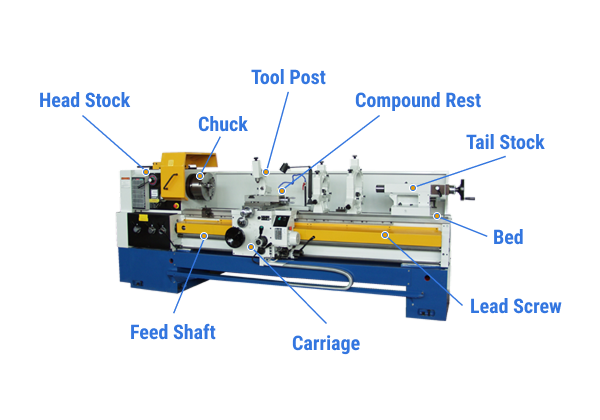
Bed: The flat, horizontal surface of the lathe that serves as the main work surface and frame. It is the base that supports the headstock, tailstock, and carriage.
Carriage: The component of a lathe that supports and controls the cutting tools.
Tailstock: Holds and supports the free end of a workpiece while it is being machined.
Headstock: The part of the lathe that houses all the necessary drive components to rotate the workpeice during a machining operation.
Chuck: This is a device that is used to hold and secure a workpiece during a machining operation
Tool post: This is a component of a lathe that holds the cutting tool and is usually positioned on top of the carriage.
Lathe Sizes:
When looking at the size of the lathe, you need to know the diameter and length of the workpieces you will be using. The size of the lathe is determined by the swing and the distance between centers. When looking at the swing, you need to know the diameter of the workpiece. When looking at the distance between centers, you need to know the length between the headstock and the tailstock. The swing and the distance between centers will tell you the maximum size of a workpiece that can be turned on the lathe.
For example, a lathe that is 8”×24” has an 8-inch maximum diameter or swing and a 24-inch distance between centers or maximum length. Lathes typically come in four size categories that increase in swing and in the distance between centers. These lathe size categories are listed below.
Another consideration is the overall weight of your lathe. Lathes can be extremely heavy, and oftentimes, the weight is not described in the size designation. Make sure to consider the weight when looking at transporting the lathe to your shop and getting it set up.
Mini or Benchtop Lathes:
The mini or benchtop size lathe typically has a swing of 6 to 12 inches and a distance between centers of 12 to 24 inches. This size lathe is optimal for small parts, educational purposes, and hobbyists. This lightweight lathe can be mounted on top of a workbench or put on a stand.
Engine Lathes or General-Purpose Lathes:
The engine or general-purpose lathe has a swing of 12 to 20 inches and a distance between centers of 36 to 72 inches. These types of lathes are common in machine shops and small metalworking shops. Engine lathes can handle a wide range of small to medium-sized parts. Engine lathes are often very heavy and will require the assistance of a forklift to move.
Medium to Large Lathes:
Medium to large lathes have a swing of 20 to 36 inches and a distance between centers of 60 to 120 inches. Medium and large lathes are used for heavier or larger diameter parts in the industrial, automotive, and aerospace industries. These lathes are extremely heavy and may require professional movers to move this size lathe into your shop.
Specialty or Heavy-Duty Lathes:
Specialty or heavy-duty lathes have a swing of over 36 inches with a long distance between centers up to several meters. Specialty lathes are used in heavy industries such as manufacturing ship parts, turbines, and other heavy industrial equipment parts. Specialty lathes are often transported and brought into a shop one piece at a time and assembled inside the shop because of their size.
Swing:
When talking about lathes, the term “swing” is the maximum diameter of material that will be turning in the spindle. Knowing this is essential before deciding on a lathe to buy. However, swing also refers to three different measurements that are necessary to understand when determining the overall swing.
Swing over the bed:
Swing over the bed is the maximum diameter of a workpiece that can be turned over the bed of the lathe without hitting the bed. To find out the swing over the bed, measure from the center of the spindle to the nearest part of the bed, then multiply the measurement by 2.
Swing over the carriage:
Swing over the carriage is the maximum diameter of a workpiece that can be turned over the carriage of the lathe without any obstructions. Because the carriage sits on top of the bed, this dimension will always be smaller than the swing over the bed.
Swing over the gap:
Swing over the gap is the maximum diameter of a workpiece that can be turned when the gap section of the bed is removed. Removing the gap allows you to turn larger diameters of material closer to the headstock. This feature is specific to gap bed style lathes.
Spindle Bore:
Spindle Bore refers to the hollow passageway that runs through the spindle of the lathe. This allows for longer bar stock to be held in the spindle. So when selecting a lathe, the size of the spindle bore will determine the largest diameter of material that can be fed through the spindle of the lathe.
In addition, the length of the spindle bore passageway will determine the length of the material that can be turned on the lathe. For safety’s sake, do not turn material that is longer than the spindle bore passageway. If you would like further explanation on this, just type in machining accidents on YouTube and see for yourself, yikes!
Conclusion:
Now you know all about lathes, their sizes, swing, and spindle bore. Armed with this knowledge, we hope you will be able to make an informed decision on what you need out of your lathe. Here at Summit Machine Tool we have the lathe that will fit your shop and needs. Take some time and browse through the options that we have available, then reach out to us with any questions and we will be happy to help.